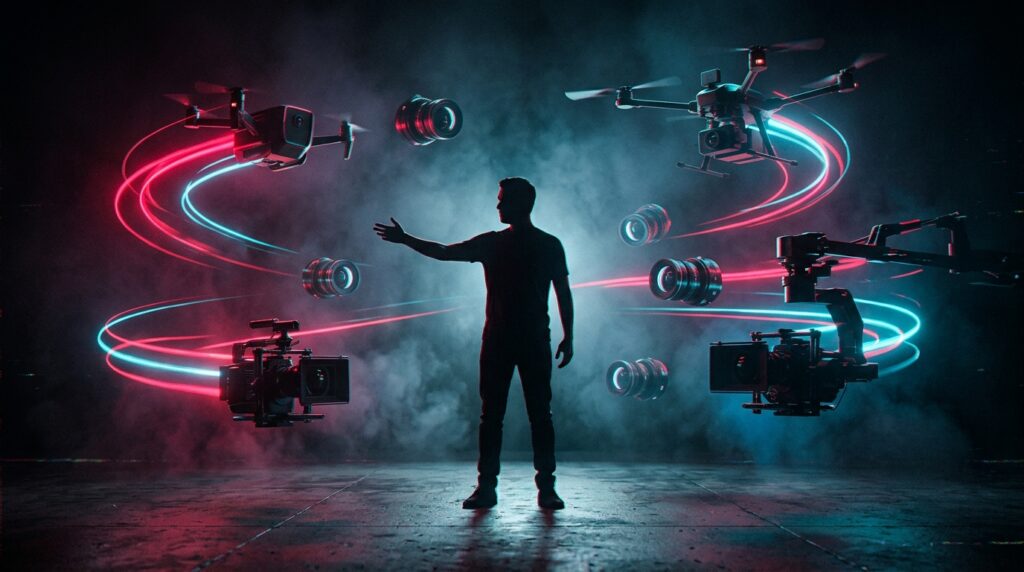
Right now there are two camps when it comes to AI in video production. One side claims AI will soon replace the entire production process. The other acts like it’s all just hype that will blow over. Both are wrong. In my day-to-day, AI in video production is neither a threat nor a toy. It’s a ridiculously fast assistant that can help with production. Creative decisions remain central.
Where AI saves me real time
The honest part first: there are tasks AI already does better, or at least faster, than I can by hand.
- Pre-production and moodboards. Different looks can be explored and compared. The selection must then fit the idea and the brand.
- Variants on demand. One hook, ten edit versions, five thumbnail ideas. The scope of the project determines which variations are useful.
- Rough cuts and transcripts. Automatic edit suggestions and clean transcripts save me the dull work of digging through footage.
- Upscaling and cleanup. Pulling old material up to 4K, removing noise, interpolating frames. Pure grunt work, perfect for the machine.
Where AI still fails
Now the uncomfortable part for the hype crowd. AI has no feel for timing. It doesn’t know why a cut an eighth of a second too early kills the whole tension. It doesn’t understand why a slightly off, honest take lands harder than the technically perfect version.
AI is my cameraman, not my director. It delivers options, but the decision about which feeling reaches the viewer is mine.
In music and entertainment especially, content lives on exactly these micro-decisions. A brand has a voice, an artist has an attitude. Neither can be prompted. You have to feel it and then carry it through with conviction.
What makes a creative decision
A look has to fit the song, the brand and the scene. Visual language, continuity and rhythm belong together. More variants are only useful when the selection criteria are clear.
What that looks like in real projects shows in cases like the Exmortus “Storm of Strings” AI video or the LOST SOCIETY AI TikTok dance: AI provides the speed, the creative line stays human. The finished film depends on selection, editing and post-production.
Bottom line
Anyone selling AI as a magic director has never rescued a cut under deadline pressure that simply didn’t work emotionally. And anyone ignoring it completely is giving away speed and budget. The interesting work of the coming years sits exactly in between: use the machine for the craft and keep your head free for what actually moves people.
For the sequence of production steps, see the practical AI video workflow. The Underdocks case study also shows my camera work and format development.
Like this?